
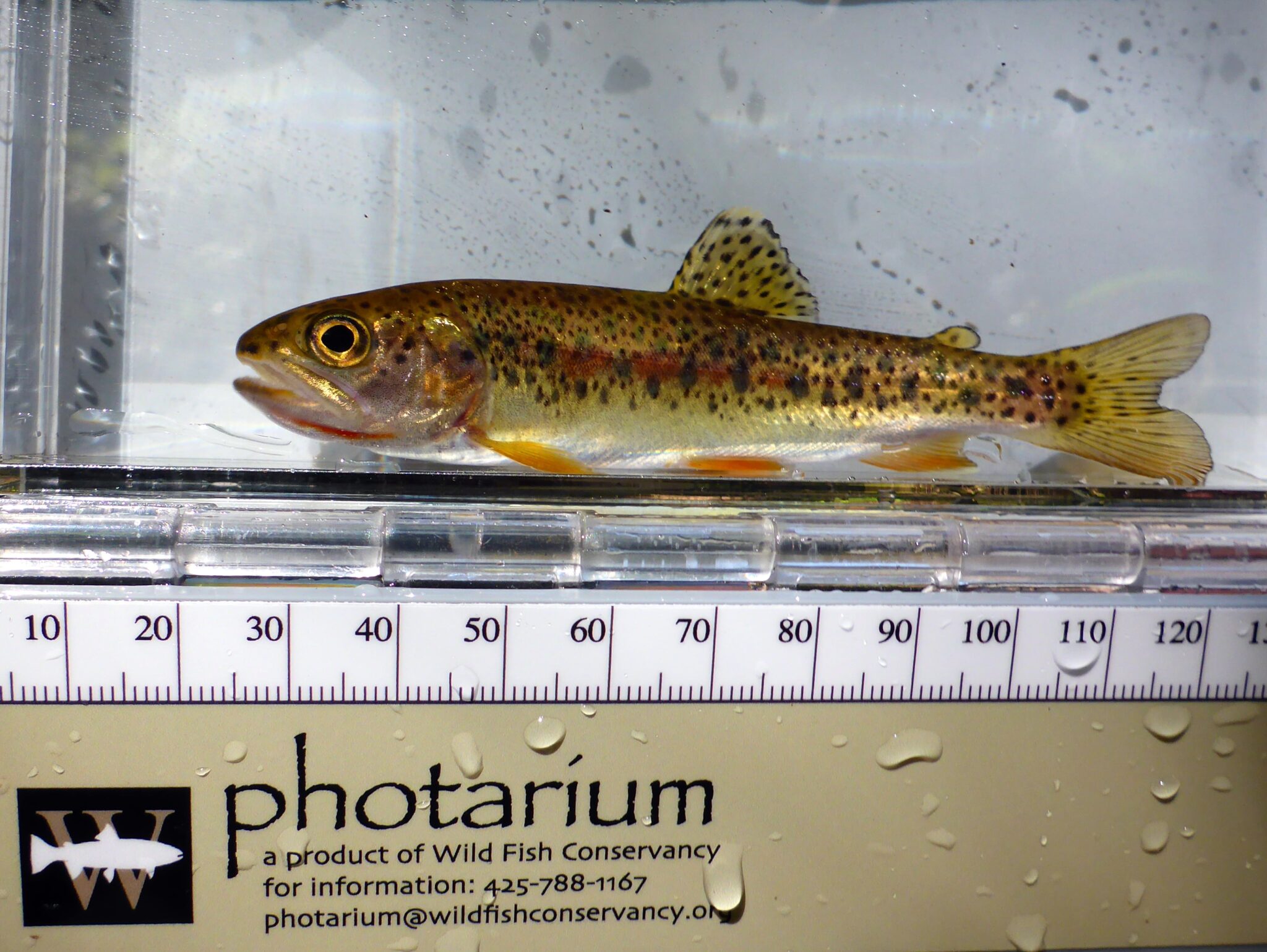
Right now, Washington’s Fish & Wildlife Commission is considering adopting the Resident Native Trout Harvest Management Policy— a framework the agency says is necessary to provide guidance to regional managers when making decisions about recreational fishing opportunities for native resident trout across the state. In theory, it should provide clear direction on when and where harvest can occur, and ensure those decisions are data-driven and consistent with conservation goals. The Commission is the body responsible for overseeing the Washington Department of Fish and Wildlife and establishing policies and oversight to ensure the agency is acting in accordance with its mandate to preserve, protect, and perpetuate fish, wildlife, and ecosystems.
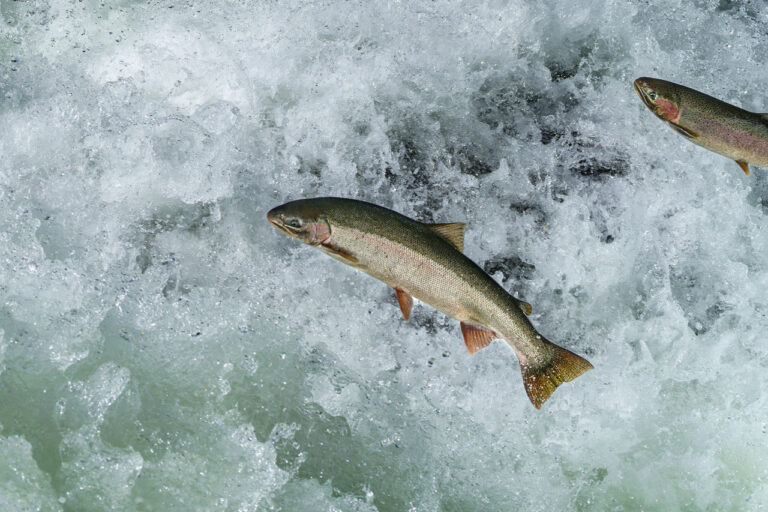
The new policy would apply to rainbow trout, redband trout, coastal cutthroat trout, and westslope cutthroat trout. Unlike anadromous salmon and steelhead, which migrate to the ocean and are covered by numerous state and federal policies, resident native trout species often receive far less attention, including research, monitoring, and protections.
This makes the Commission’s decision especially significant: it will shape when, where, and how harvest is allowed across the state — with profound consequences for the future of Washington’s native resident trout.
The policy process began when our friends at the Wild Steelhead Coalition submitted a formal petition to the Commission seeking new rules to protect resident forms of wild steelhead that often spend one to four or more years in freshwater before migrating to the ocean. The petition, as seen below, noted that these young fish are highly vulnerable to undocumented fishing mortality and lack adequate protections under current rules.
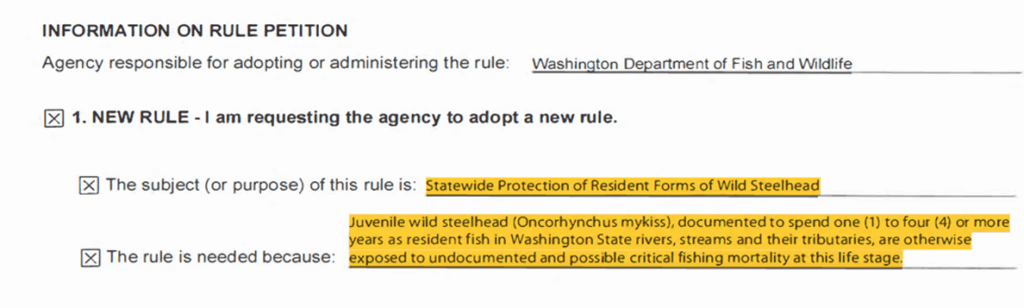
WDFW staff ultimately recommended that the Commission deny the petition and instead create a statewide harvest management policy to guide future rulemakings for all native resident trout.
However, in a troubling twist, the Department’s draft policy has effectively reversed the petition’s proactive conservation intent. Rather than developing rules focused on the statewide protection of resident forms of wild steelhead, they have drafted a vague, high-level harvest management policy, that as written, could open the door to increased harvest of all native resident trout species statewide— including in cases where data on population health are limited or nonexistent.
It is concerning that a petition from the public rooted in protecting wild fish is being repurposed into a tool that could cause additional harm to vulnerable populations. This bait-and-switch not only undermines the original intent of the petition but also raises a broader question: Is WDFW truly committed to conservation first, or primarily focused on justifying increased harvest opportunities?
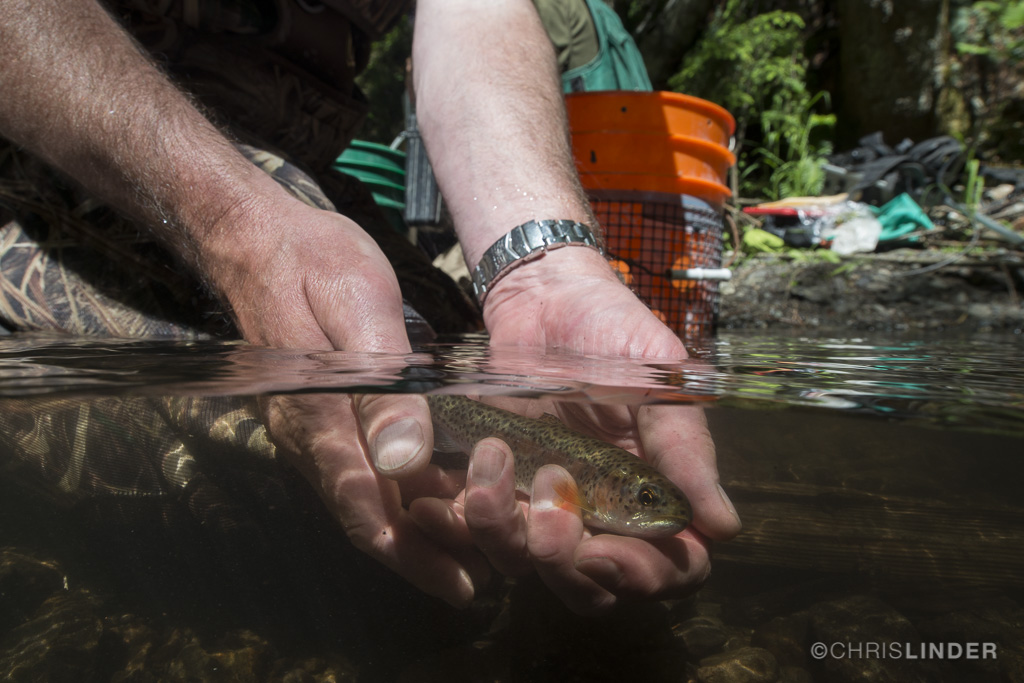
In early July, the public had its first formal opportunity to weigh in when WDFW reviewed the draft policy under the State Environmental Policy Act (SEPA) — Washington’s process for identifying and analyzing environmental impacts to ensure government decisions do not cause irreparable harm to the public trust. Staff subsequently presented an overview of the public comments to the Fish Committee of the Fish and Wildlife Commission on August 14th. Out of the entire state, only six comments were submitted, and Wild Fish Conservancy was one of just three organizations to weigh in.
The draft policy contains several critical weaknesses. It assumes recreational harvest is inherently compatible with conservation without credible science; sidesteps comprehensive environmental review of the environmental impacts by issuing a “Determination of Nonsignificance” under SEPA; invokes “adaptive management” without rules, triggers, or measurable standards; and completely ignores the compounding effects of hatchery production, which directly interact with and influence harvest outcomes. By keeping these provisions vague and unenforceable, the policy risks putting recreational fishing access ahead of conservation—creating an illusion of protection without providing real safeguards.
Our core concern is clear and non-negotiable: harvest should not be permitted in areas where little or no data exist to demonstrate the health of native trout populations. Without this safeguard, fishing could occur without understanding population status, putting vulnerable populations at risk. Where conservation objectives are met and supported by credible data, harvest could be considered, but absent that data, the benefit of the doubt must go to protecting native fish.
Before advancing this policy, the Commission must advocate for the draft policy to include stronger protections for native resident trout and to provide meaningful guidance to the regional fish managers on the frontlines tasked with these important decisions. Establishing a precautionary, evidence-based standard now would protect vulnerable populations, set a clear example of responsible management, and provide a strong foundation for future fishing rules grounded in sound science.
This central precaution must be accompanied by additional measures to make the policy truly protective and actionable. The Commission should require clear, measurable conservation standards to define sustainability, ensure adaptive management is operational and data-driven, integrate the ecological and genetic impacts of resident trout hatchery programs, and guarantee meaningful environmental review and public accountability. Together, these steps give regional managers real guidance, safeguard populations, and demonstrate leadership in balancing conservation and recreational opportunity.
Read Wild Fish Conservancy’s full comments here.
The Public’s Comments Are Making a Difference
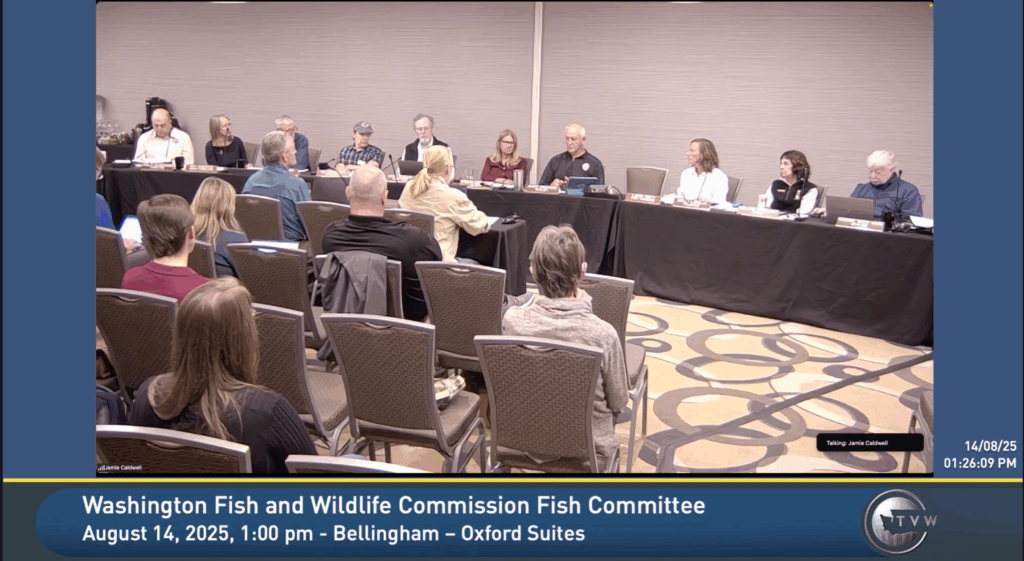
While few in number, the public comments from Wild Fish Conservancy and others clearly had a large impact on the Commission’s consideration of the draft policy. At the August 14th Fish Committee meeting, WDFW staff presented an overview of all comments, and we were encouraged to hear Commissioners actively engage with the issues, asking thoughtful questions and echoing many of our concerns — including the policy’s vagueness, lack of measurable standards, failure to analyze impacts, and deferral of review.
Commissioner Steve Parker asked staff to confirm that the goal of the policy should be to prioritize more conservative management, including prohibiting harvest in areas where there is little to no data on trout population health. Staff agreed but then added that “even when we don’t have empirical evidence, there are other ways to meet conservation objectives”, without explaining what those alteratnive smight be— a troublingly vague response.
Multiple Commissioners expressed concern that the draft is simply too vague to guide regional managers and discussed that this is the responsibility of the Commission in drafting such a guidance policy. Commissioner John Lehmkuhl asked staff whether adopting the public’s recommendations to strengthen the policy’s conservation objectives would still result in a Determination of Nonsignificance (DNS). Staff admitted the answer was likely no — claiming, adding clear standards and triggers would transform the draft from a high-level policy into project-level implementation, triggering further environmental review. Staff strongly discouraged making the policy more specific, raising concern that the policy’s lack of clarity could serve as a shield against meaningful environmental review — another example reinforcing concerns among the conservation community and legal experts that vague policies are being used to limit accountability.
Commissioner Molly Linville asked staff to clarify whether there will ever be a point when the Department conducts review of the environmental impact of specific management plans guided by this policy that could negatively impact native resident trout. Staff responded that such details would need to be addressed later through SEPA planning or rulemaking. But this “kick the can” approach delays real conservation commitments — forcing dozens of piecemeal reviews across the state instead of one thorough evaluation now. It reduces efficiency, transparency, and public influence, making it easier to expand harvest while avoiding the accountability SEPA is designed to ensure.
Equally concerning, staff claimed later “review” could occur through SEPA or rulemaking. That may sound reassuring, but it isn’t — because rulemaking is not environmental review and treating it as such strips the public of real influence and accountability. It may feel like we’re diving into the weeds, but this distinction is critical.
SEPA requires agencies to study and disclose environmental impacts and gives the public meaningful influence over decisions: comments must be considered, alternatives and mitigation measures can be required, and decisions can be challenged in court if review is inadequate. Rulemaking, by contrast, is simply the legal process for creating regulations. While it includes a public comment period, agencies have broad discretion, and courts rarely overturn adopted rules unless they clearly violate the law. By treating SEPA as something that can just “happen later” or replaced through future rulemaking, WDFW is undermining both the spirit and letter of the law.
In practice, such promised future reviews sometimes never occur at all, leaving policy to advance without any meaningful environmental analysis. This is part of a larger pattern — one WFC is already challenging in three separate lawsuits over the Department’s systemic misuse of DNS findings that put already declining wild salmon, steelhead, and orcas at even greater risk of harm.
For the Resident Native Trout Harvest Management Policy, we’re calling for the opposite approach: set clear conservation standards now that apply across the board and then consider exceptions only when justified by strong evidence. That’s the efficient, transparent, responsible, and protective way to manage our treasured native resident trout. Otherwise, high-level policies like this one move forward with little analysis, and later rulemaking provides the public far less power to shape outcomes or hold the Department accountable.
What’s Next
After the Commission requested changes to the policy, WDFW staff presented revised draft language to the Commission’s Fish Committee on September 11. The changes made do not address the concerns raised above and, in some ways, make the policy even more vague. Although several Commissioners agreed further clarity is needed, they ultimately agreed to advance the draft to the full nine-member Commission who are expected to consider the Resident Native Trout Harvest Management Policy for adoption later this fall.
Wild Fish Conservancy is committed to monitor every step of this process and will continue pressing for necessary changes to the policy before any final decision is made. As soon as the Commission sets a timeline for public testimony or written comment, we will share clear instructions on how you can make your voice heard—whether that means submitting comments, attending the hearing, or contacting Commissioners directly.
Your engagement will be critical to ensuring the final policy will adequately protect Washington’s native resident trout for current and future generations. Thank you again for your support that makes our work possible!
Your Support Matters
Time and again, Wild Fish Conservancy (WFC) has been one of the only groups willing to challenge government when they abandon or evade their responsibility to protect wild fish and their ecosystems. This can include sidestepping environmental review or advancing policies that put politics and profits ahead of conservation and the public trust. Without this important watchdogging, deeply problematic decisions would move forward with little scrutiny and no public oversight.
With the current federal administration rolling back environmental protections, eliminating funding for research and conservation initiatives, and limiting oversight, this work is more important and more challenging than ever. It requires even greater vigilance, expertise, and persistence to ensure that science and public accountability guide decisions that will determine whether future generations will have the same opportunities to experience and enjoy our region’s iconic wild fish heritage.
Very few organizations are willing to take on this fight — and it takes tremendous time and resources. Our staff dig into technical documents, track endless policy processes, and prepare detailed scientific and legal analysis that would otherwise never reach the public record. Many of these issues we’ve been following for decades, building deep expertise and institutional knowledge that ensures no decision goes unexamined.
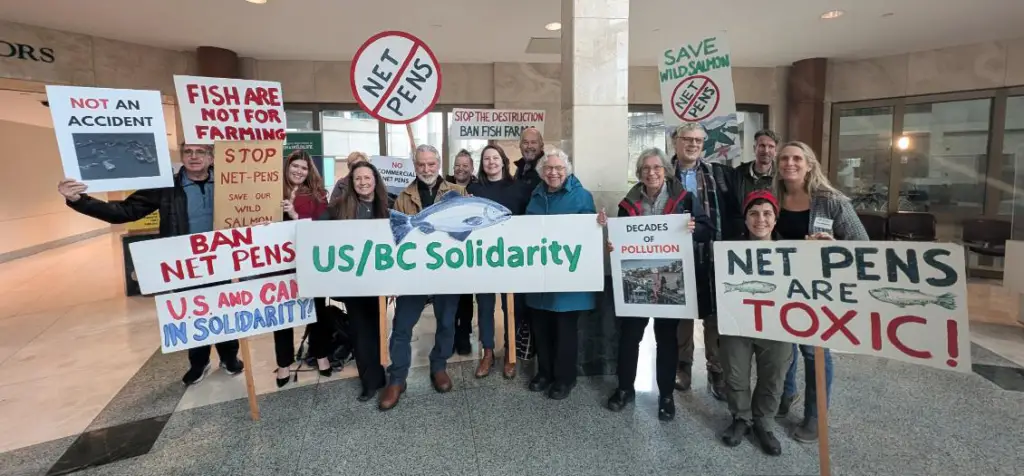
You’ve seen this in action before. When WDFW tried to expand commercial net pen aquaculture in Puget Sound, they attempted to push the project forward while sidestepping comprehensive SEPA review — just as they are doing in the current issue. Wild Fish Conservancy took the fight all the way to the Washington State Supreme Court. That effort, alongside years of persistent advocacy, helped secure this year’s historic, permanent ban on commercial net pen aquaculture in Washington waters.
That’s why your support is essential. Without you, this work would never be possible. With you, we’re holding agencies accountable, ensuring science guides decisions, and giving wild fish — from native trout to salmon and steelhead — the strong advocates they need. Support this work and become a member by making a donation today.