
Contact:
Emma Helverson, Wild Fish Conservancy, (484) 788-1174, emma@wildfishconservancy.org
Brian Knutsen, Kampmeier & Knutsen PLLC, (503) 841-6515, brian@kampmeierknutsen.com
For Immediate Release
May 14, 2026
PDF Version
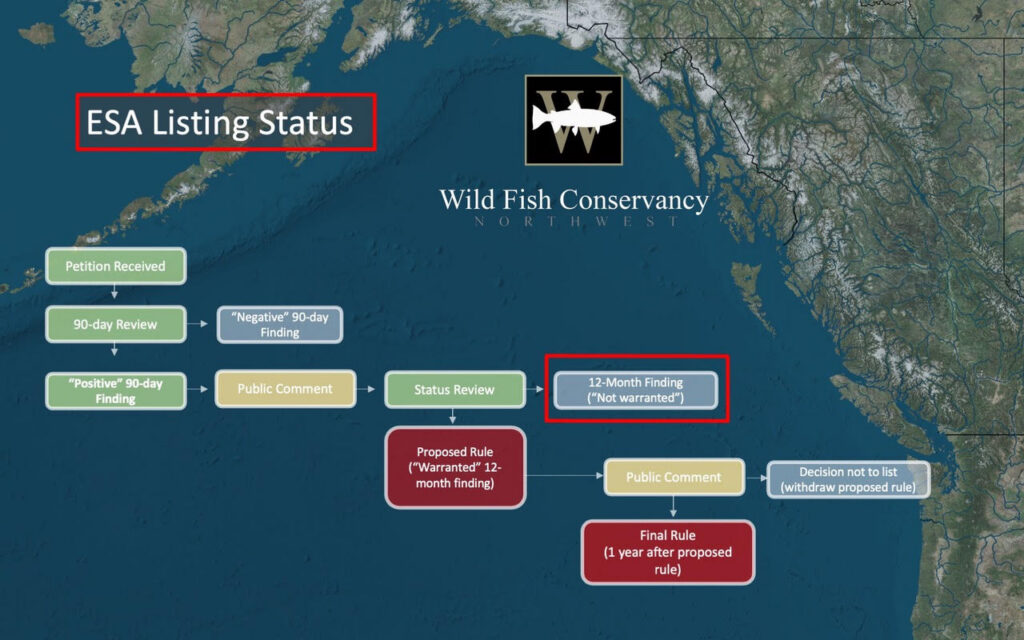
WASHINGTON, D.C.—Today, under the pressure of a federal court order, the National Marine Fisheries Service (also known as NOAA Fisheries) released its long-overdue 12-month finding on Wild Fish Conservancy’s petition to protect Gulf of Alaska Chinook under the Endangered Species Act (ESA). The finding concludes protections for Gulf of Alaska Chinook salmon are “not warranted” at this time despite documented widespread declines in Chinook abundance, size, and productivity throughout the region.
Wild Fish Conservancy is now conducting a thorough scientific and legal review of the finding, methodology, and the underlying status review documents. A full analysis is forthcoming.
“The scale and geographic extent of the crisis facing Chinook across the Gulf of Alaska make this conclusion deserving of careful scrutiny,” said Emma Helverson, Executive Director of Wild Fish Conservancy. “We are reviewing both the agency’s scientific conclusions and the legal framework underlying this decision before determining next steps.”
As part of its assessment, NOAA Fisheries was required to formally delineate Gulf of Alaska Chinook populations into genetically distinct Evolutionarily Significant Units (ESUs) for the first time. ESUs play a critical role in determining how salmon are evaluated and protected under the Endangered Species Act. Broad ESU boundaries can allow weaker or declining local populations to continue disappearing so long as the larger regional grouping remains sufficiently abundant overall, potentially masking the loss of important genetic and ecological diversity that helps Chinook adapt and persist over time.
Despite longstanding evidence of substantial biological and geographic diversity across Alaska’s Chinook populations, the agency lumped the Gulf of Alaska Chinook into just three broad ESUs spanning enormous geographic areas. For comparison, a similar distance of coastline in the lower 48 holds 16 unique ESUs of Chinook salmon across Oregon, Washington, Idaho, and California.
“The formal designation of these Evolutionary Significant Units is an important first step to better understanding unique threats driving the decline of individual Chinook populations and acknowledging these fish are distinct and irreplaceable,” said Helverson. “At the same time, a map is not a recovery plan. Drawing broad boundaries around declining populations without extending Endangered Species Act protections or resources raises serious questions that deserve careful scientific and legal scrutiny.”
The federal government had the opportunity to list one or more of these newly defined units for protection under the ESA, but chose a path of minimal intervention that continues Alaska’s existing “business as usual” management approach despite unprecedented fisheries closures and widespread concern surrounding Gulf of Alaska Chinook declines.
“Telling the public that the Gulf of Alaska Chinook are stabilizing while communities continue watching local populations decline risks creating a dangerous disconnect between agency credibility and the reality on the ground,” said Helverson. “For many Alaskans, this finding will be difficult to square with what they are seeing happen in their home rivers year after year.”
Wild Fish Conservancy will release a full technical breakdown of its findings once its scientific and legal review is complete. The public is encouraged to submit their legal concerns through the Conservancy’s anonymous online portal.
###
Wild Fish Conservancy is represented by Kampmeier & Knutsen PLLC of Portland, Oregon and Seattle, Washington and Eubanks & Associates, PLLC, of Washington D.C. kampmeierknutsen.com
Wild Fish Conservancy is a nonprofit conservation organization headquartered in Washington State and working from California to Alaska to preserve, protect and restore the northwest’s wild fish and the ecosystems they depend on, through science, education, and advocacy. wildfishconservancy.org
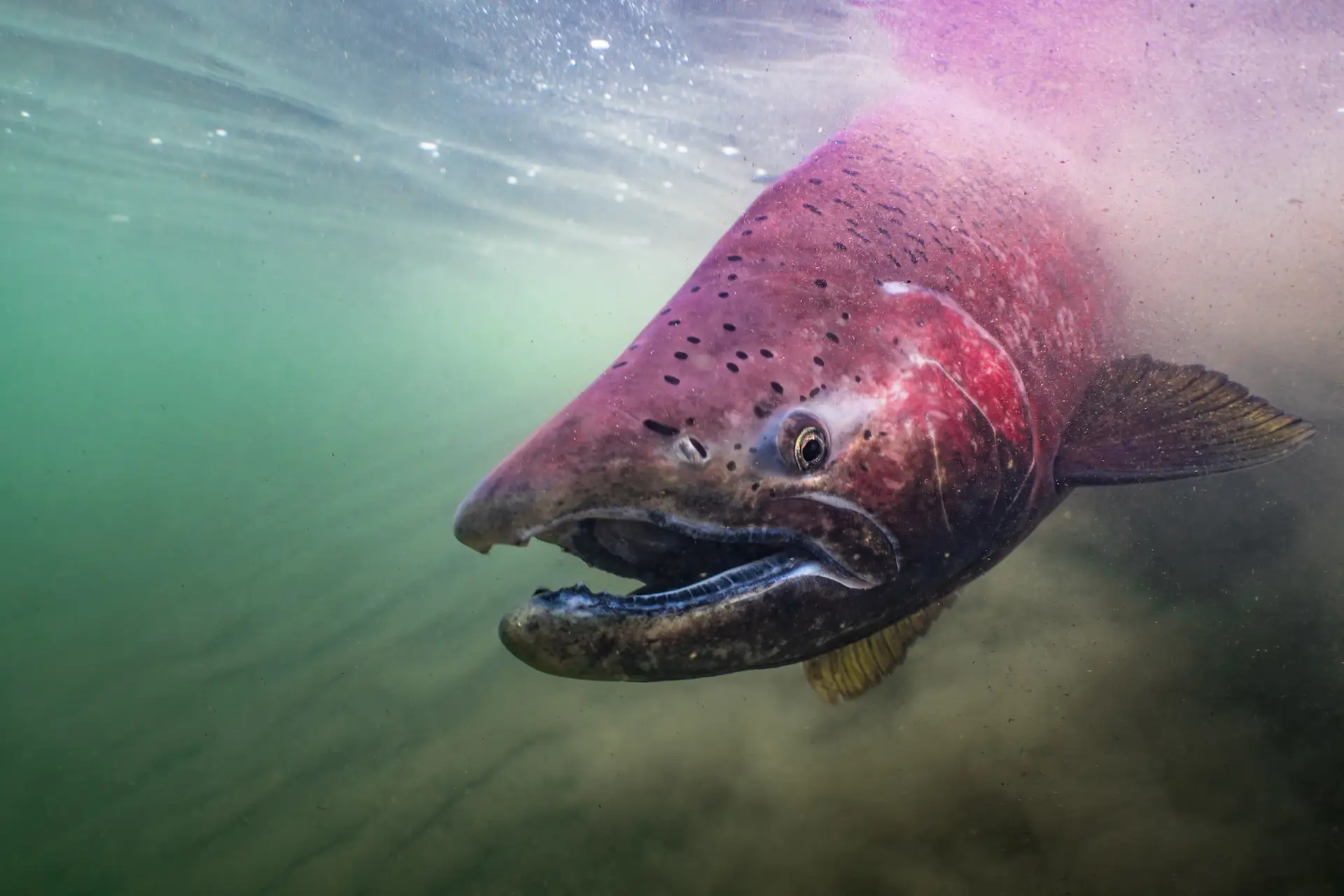
Photo: Alaskan Chinook by Conrad Gowell