
Industrial Aquaculture Proponents Give Up In Legal Challenge, Wild Fish Conservancy and Center for Food Safety Celebrate Victory
March 31, 2026
OLYMPIA, WA – A Washington State court yesterday issued an order upholding the State’s historic ban on commercial finfish net pen aquaculture. The state court granted a motion from aquaculture industry petitioners to dismiss their lawsuit contesting the ban, marking the end of their efforts to overturn one of the strongest protections for marine waters in the United States.
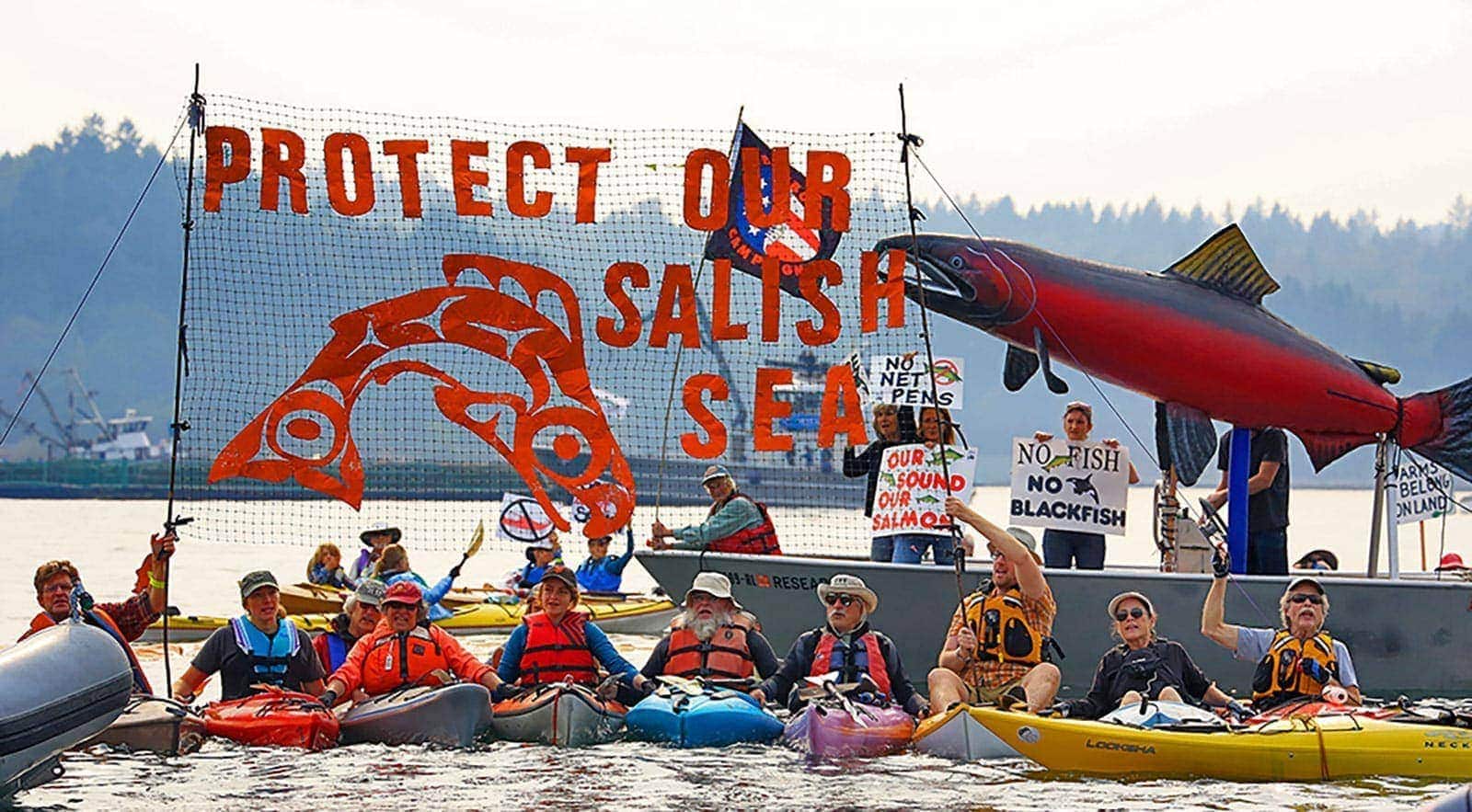
Following a devastating 2017 net pen aquaculture collapse in Puget Sound that released a quarter-million farmed non-native and viral-infected Atlantic salmon, Washington State banned commercial fish farming in state marine waters, the result of a years-long public movement and Our Sound, Our Salmon campaign led by Wild Fish Conservancy, alongside the leadership of Tribal Nations. In January 2025, the Washington State Department of Natural Resources led by former Commissioner Hilary Franz issued its final rule implementing the state law, which was promptly challenged by the Northwest Aquaculture Alliance, a pro-industrial aquaculture trade association that includes Cooke Aquaculture, the company responsible for the 2017 collapse. Wild Fish Conservancy and Center for Food Safety (CFS) intervened to defend the state rule. The Intervenors were represented by counsel from Kampmeier & Knutsen PLLC and CFS.
“This is a landmark, decisive victory for Washington, closing the chapter on a long fight led by the public to protect the health of Puget Sound,” said Emma Helverson, Executive Director of Wild Fish Conservancy. “For nearly a decade, the public took on a powerful global industry and fought tirelessly to reclaim our waters and turn that vision into lasting law. With this final challenge dismissed, the fight is over. This industry is gone, the ban is permanent, and commercial net pen aquaculture will never again threaten the health of our wild salmon, orcas, or Puget Sound. This victory stands as a testament to what we can achieve when we stand together with the law and science on our side.”
“Washington made history by banning this dangerous industry from our public waters. It serves as a model for other states seeking to preserve our oceans for future generations. The aquaculture industry’s decision to give up its challenge affirms what science and the public have made clear for years: these operations pose unacceptable risks and were properly outlawed,” said Kingsly A. McConnell, Staff Attorney for Center for Food Safety, an Intervenor in the case.
Background
Industrial net pen aquaculture has well-established adverse environmental and socioeconomic impacts, including untreated daily pollution from drugs, chemicals, pesticides, fungicides and pharmaceuticals; nutrient pollution from uneaten fish food and fish waste; the spread and amplification of parasites, viruses, and disease from farmed fish to wild fish; broader ecological effects on marine wildlife; and harm to traditional and indigenous fishing cultures and communities through privatizing ocean resources. Chronic fish spills, both small-scale leakage and massive escape events, caused by equipment failure, human error, or weather, are among the worst causes of harm. Escaped fish harm wild fish by competing for food and habitat, spreading viruses and disease, and inbreeding, thus reducing genetic diversity and resilience. Worldwide, over 25 million farmed fish were reported to have escaped between 1996 and 2012.
Over nearly a decade, the Our Sound, Our Salmon campaign—led by Wild Fish Conservancy—mobilized a broad coalition of more than 100 businesses and organizations and tens of thousands of individuals, working alongside sovereign Tribal Nations to end commercial net pen aquaculture in Puget Sound. Catalyzed by the 2017 Cypress Island collapse, the campaign advanced science-based advocacy and secured landmark 2018 legislation phasing out Atlantic salmon farming, then successfully challenged the industry’s attempted transition to native species and fought the renewal of net pen leases. The campaign also exposed and helped halt the amplification and spread of an exotic virus by exposing the industry was importing fish infected with a nonnative virus. These efforts culminated in the complete removal of the commercial net pen industry from Puget Sound and a subsequent 2025 rule permanently banning the practice into the future—ending decades of pollution and ecological risk and establishing a global precedent for protecting public waters from this dangerous industry.
Previous Coverage: