
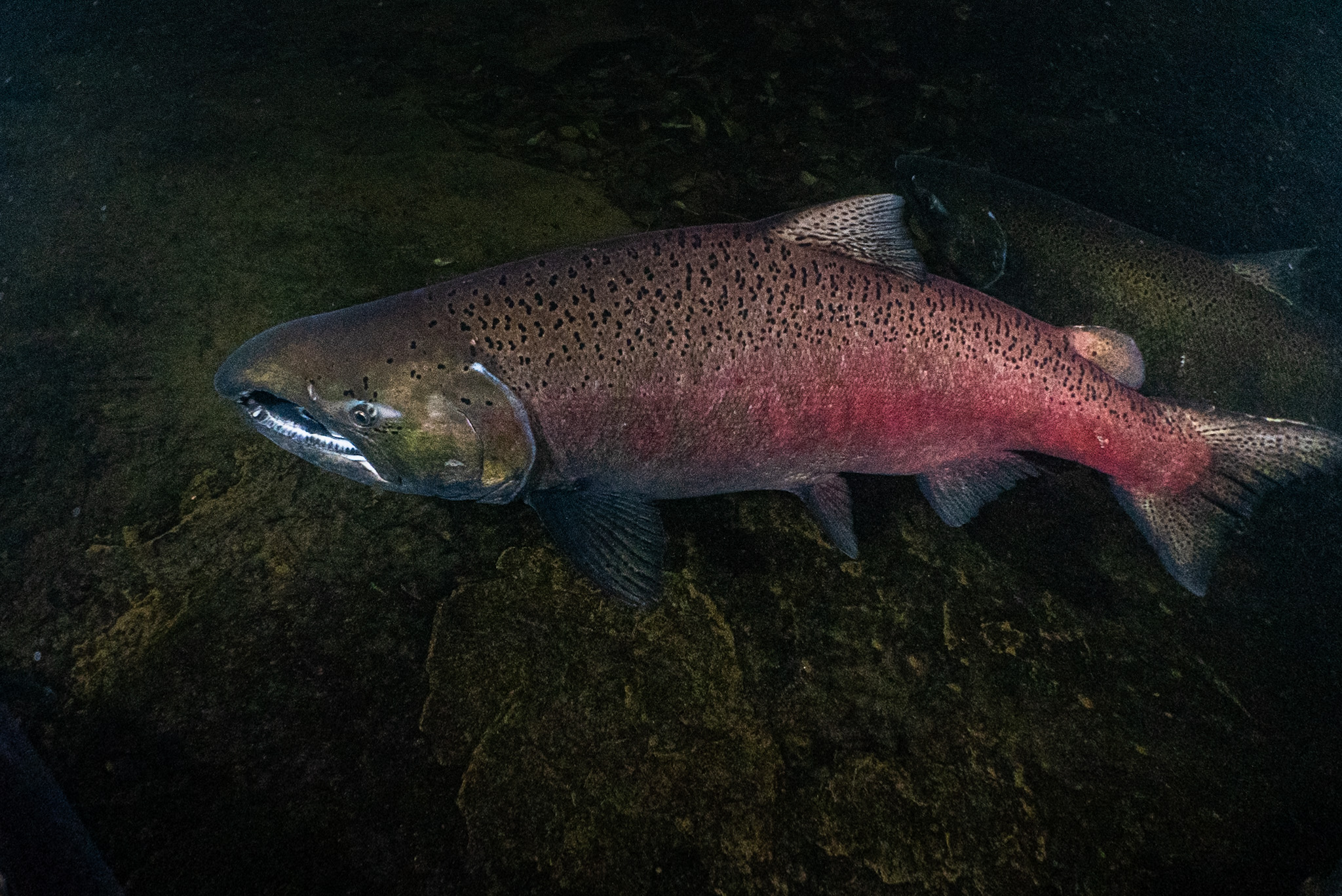
Revised Pacific Salmon Commission data reveal substantially more Puget Sound Chinook were intercepted in ocean fisheries over a twenty-year period, harming local communities and undermining decades of salmon and orca recovery efforts.
For Immediate Release
June 10, 2026
PDF Version
PUGET SOUND, WA—Newly revised data released by Canada at the Pacific Salmon Commission shows that for more than two decades ocean fisheries have killed thousands more Endangered Species Act-listed Puget Sound Chinook salmon each year than previously understood. The corrected estimates reveal far higher harvest mortality in British Columbia’s ocean recreational fisheries, with cascading consequences: lost opportunities to recover Puget Sound Chinook, less prey for endangered Southern Resident orcas, and tighter constraints on local fishing communities.
The scope of the oversight raises hard questions for the fishing families, Tribal Nations, and communities who spent decades accepting closed or curtailed fishing seasons, funding recovery efforts, and backing major conservation measures under the assumption that substantially more Chinook were surviving ocean harvest. It also raises concerns about transparency and accountability, as revisions with major implications for salmon recovery and fishing opportunity were incorporated into technical management processes with little to no public explanation.
For two decades, fisheries managers set salmon recovery targets, determined harvest limits, and assessed prey availability for endangered Southern Resident killer whales while relying on inaccurate data that failed to reflect the true scale of ocean interceptions. In some Central and North Puget Sound watersheds, including the Nooksack, Skagit, and Stillaguamish rivers, revised estimates show that Alaska and British Columbia interception rates exceeded a stunning 60% of returning adult Chinook before those fish reached Puget Sound waters. During this same period, many of these rivers repeatedly failed to meet recovery goals and Southern Resident killer whales continued to decline.
Interception fisheries are an unfortunate product of outdated management frameworks enshrined in the Pacific Salmon Treaty. Even before the revised estimates, distant ocean fisheries were already intercepting far more Chinook from Puget Sound watersheds than fisheries closer to home. According to Pacific Salmon Commission data, ocean fisheries in British Columbia and Alaska harvest roughly four to six times more Chinook from the Nooksack, Skagit, Stillaguamish, and Snohomish watersheds than all local Puget Sound tribal, commercial, and recreational fisheries combined. Meanwhile, many local fisheries in Puget Sound have lost most opportunities to harvest returning Chinook from their own watersheds. For example, in 2025, the Stillaguamish Tribe was limited to a ceremonial harvest of only 26 Chinook salmon.
The revised estimates followed an update to the accounting method used by fisheries managers in British Columbia. The previous method, in place for two decades, had significantly understated Chinook harvest and mortality in ‘mixed-stock ocean fisheries’, where weak and recovering salmon populations from rivers coastwide are indiscriminately harvested alongside healthier stocks across vast marine areas.
“We already knew Puget Sound Chinook and Southern Resident killer whales were in crisis,” said Dr. Nick Gayeski, Senior Ecologist with Wild Fish Conservancy. “Canada’s underestimate of recreational Chinook harvest show that ocean interceptions were substantially higher than previously understood during a critical period for Chinook and killer whale recovery. These findings expose the profound uncertainty and risk inherent in attempting to manage salmon populations from rivers coastwide in large mixed-stock ocean fisheries.”
More than 25 years after Puget Sound Chinook salmon were listed under the Endangered Species Act (ESA), many of the populations that make up the listed stock remain far below recovery goals and are now identified as “in crisis” by Washington’s Governor’s Salmon Recovery Office. Southern Resident killer whales were listed as endangered under the ESA in 2005 and have declined approximately 20% over the last two decades to just 76 whales today. Reduced prey availability, particularly large and abundant Chinook, has been identified by killer whale experts and NOAA Fisheries as the leading cause of the whales’ decline. Recent research suggests that reducing ocean interceptions of Chinook salmon before they reach critical Southern Resident killer whale feeding areas could substantially increase prey availability, including modeled increases of up to 25% in Chinook abundance within whale critical habitat.
Importantly, the revised data are not an isolated anomaly or merely a technical correction. They reveal a broader structural problem in attempting to manage salmon populations in mixed-stock ocean fisheries. Despite increasingly sophisticated monitoring and modeling, uncertainty remains high and populations continue to be overharvested under this system.
The new data underscore that uncertainty and raise an important question: if one correction can dramatically change estimates of Chinook mortality, what other sources of uncertainty and risk remain within the management system?
“For decades, fisheries management has prioritized maximizing extraction in mixed-stock ocean fisheries rather than maximizing salmon recovery,” said Emma Helverson, Executive Director for Wild Fish Conservancy. “That approach is failing Chinook salmon, Southern Resident killer whales, tribal treaty fisheries, and fishing communities alike. Ironically, maximizing short-term ocean harvest is reducing long-term fishing opportunities across the coast. Recovering salmon will require transformational changes in where, when, and how fishing occurs to ensure more fish survive to return home.”
This new understanding comes at a consequential time when the U.S. and Canada prepare to renegotiate the Pacific Salmon Treaty, the international agreement that governs coastwide salmon harvest and many of the mixed-stock ocean fisheries now facing renewed scrutiny. Across the Pacific Coast, communities are increasingly calling for major fisheries reforms to reduce interceptions and transition harvest closer to rivers and estuaries, where salmon can be more selectively and sustainably managed as they return home.
“The Pacific Salmon Treaty renegotiation is happening right now and offers a once-in-a-decade opportunity to redirect salmon management toward a more sustainable and equitable path,” said Helverson. “We do not have another decade to wait. Chinook salmon, Southern Resident killer whales, and coastal communities are already paying the price for a management system that is failing to rebuild abundance. This is the moment for transformational change.”
Updated Chinook mortality distribution tables and stock-specific harvest data are publicly available through the Pacific Salmon Commission Chinook Technical Committee data portal and data application.
Pacific Salmon Commission Chinook Technical Committee. Annual Report of Catch and Escapement for 2024. Appendix C: Comparison of Historic and Updated Canadian Recreational Catch and Release Estimates is available here for download: Pacific Salmon Commission Appendix C Data Tables
###
Wild Fish Conservancy is a nonprofit conservation organization headquartered in Washington State and working from California to Alaska to preserve, protect and restore the northwest’s wild fish and the ecosystems they depend on, through science, education, and advocacy. wildfishconservancy.org